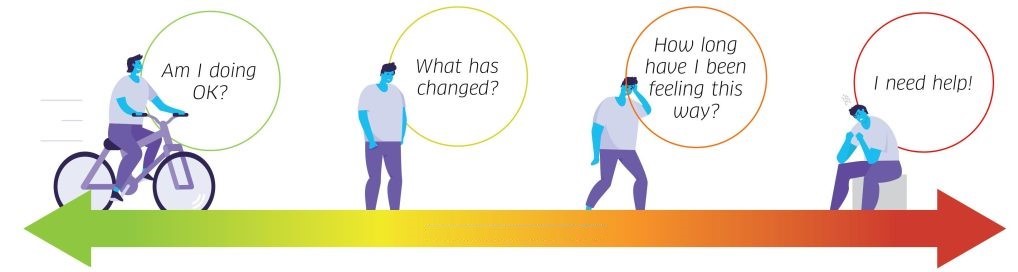
Take a moment to note any changes in yourself and ask yourself : How am I doing?
Using the Mental Health Continuum Tool will help you notice and be able to talk about changes in yourself, your peers, friends, or family members. Take a moment to note any changes in yourself and ask yourself : How am I doing?
Note: This is not a self-diagnostic tool but rather a way to build your self-awareness about your mental health.
As your mental health is constantly changing, you can repeat this reflection as often as you wish.
Take a minute when on break, or wherever you are, to see where you are on the continuum.
Text or call a friend or family member and use the colours to talk about how you are feeling, coping, or reacting in the moment.
Do a “colour” check-in at the beginning of a shift, team meeting or debrief.
Actions You Can Take
Click on the four phases of the continuum to learn more about appropriate actions you can take in each colour phase.
Now think of three things that you can do or say that will help you right now.
What actions can you take?
What strategies can you adopt?
Where can you go or who can you talk to?
Note: Your comments are for your own self-awareness and reflection and will not be recorded or reviewed after submission.
The Working Mind First Responders The Mental Health Continuum Booster
Green: Practicing Coping Skills
Ask yourself : “Am I doing okay?”
Making healthy lifestyle choices such as eating well and exercising regularly, participating in activities you enjoy, spending time with friends, and finding a sense of meaning or purpose may help you stay in balance.
Practicing all of the Big 4 strategies that you learned in the course (tactical breathing, self-talk, mental rehearsal, goal setting).
Remember, staying in the green does takes work. It requires actively practicing coping strategies to build resilience, while staying connected with social support.
Yellow: Noticing Changes
Ask yourself: “What has changed?”
Pay attention any changes in yourself in all areas of the continuum. For example, you might notice a decrease in physical performance – you might feel tired all of the time. Or your mood might change – you were normally happy and now seem to be easily irritated. Work on getting some good sleep and eating well.
Yellow: Reaching out to your Social Networks
Ask yourself: “Who can I talk to?”
Keep in mind the power of social support. If you can speak about the problem with a family member, friend, or trusted co-worker, that might be all the help you need. Know who to talk to about work or personal matters and whom you can go to if you want to vent, or problem solve. If this does not fully help, then you should consider seeking appropriate professional help, the earlier the better.
Yellow: Getting to Know Available Resources
Ask yourself: “If I need help where can I go?”
Even if you’re healthy, it is a good idea to get to know about community and workplace resources and find out how to access them. It will make it easier to do so when you or a peer really needs them.
Look for a range of supports and resources: 24-hour help phone or chat lines, professional counselling and therapy services, peer support groups, spiritual leaders, and employee and family assistance programs.
Orange: Seeking Professional Help
Ask yourself: “How long have I been feeling this way?”
It is completely natural to feel sad, worried, scared, or suspicious at times. If these feelings persist for an extended period of time, for example two weeks or more, they could become problematic and indicate a possible mental health problem.
It’s a good idea to seek help appropriate professional help if a problem starts to negatively impact your life, work, or relationships. Some people seek help even before they have a significant problem. Prevention or maintaining your mental health is a better strategy than waiting until you have a problem to get help.
Red: Getting Help Now
Tell yourself: “I need help!”
If you find your signs and indicators are in the red phase of the continuum, or you are having suicidal thoughts. Get help now by contacting a trained professional who can help you. You can call or text a crisis line or speak to counsellor or medical doctor. Don’t wait!